You've probably noticed your workers' comp renewal doesn't feel as easy as it used to.
Rates are creeping up. Carriers are getting pickier. And if you've had a clean claims history and still saw an increase, you're probably wondering why.
Here's the honest answer: it's not just bad luck. In most cases, it comes down to how your program is built — and whether that structure still makes sense in the market we're heading into.
The Market Is Shifting
There are clear indications the workers’ comp market is starting to tighten. Carriers are becoming more selective. Medical costs are rising. Claims are taking longer to resolve. Litigation is increasing. And in many cases, insurers are beginning to pay out more than they’re collecting in premiums.
When that happens, the market corrects itself — through higher rates, stricter underwriting, and less wiggle room at renewal. This isn't a temporary blip. It's a recalibration, and it's hitting California businesses especially hard right now.
The frustrating part? Even businesses doing everything right — strong safety culture, low claims, good management — are feeling it. That's when most people assume it's just "the market." But there's usually more to it than that.
The Part Nobody Talks About
Most traditional workers' comp policies operate inside a shared risk pool. Your base rate isn't just based on your own claims history — it's influenced by the performance of every other business across your industry.
Run a tight operation, zero accidents, great safety record? You can still end up paying for someone else's bad year.
In a soft market, this is easy to overlook. Costs are low enough that the inefficiency stays hidden. But when the market tightens, it surfaces fast — and suddenly your bill doesn't match your performance. That's not random. That's structural.
There's More Than One Way to Structure This
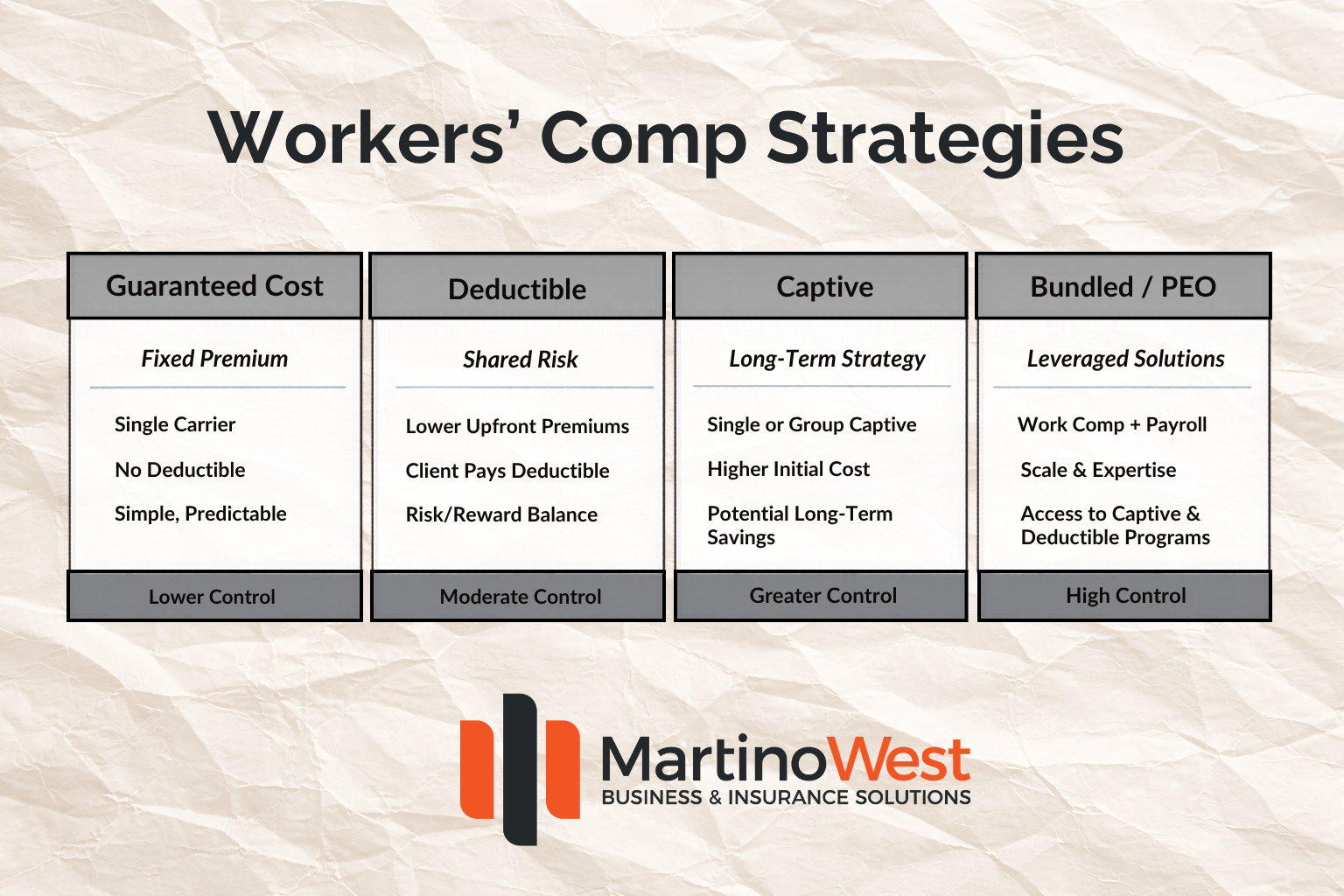
This is where most business owners get stuck — because they've only ever seen one option: get quotes every year, pick the lowest price, repeat. But workers' comp can actually be structured several different ways, and the right fit depends on your size, your risk profile, and your long-term goals.
Here are four of the most common structures businesses should understand:
- Traditional (Guaranteed Cost) — The most common setup. Simple and predictable, but you're fully exposed to carrier pricing and the shared pool. In a tightening market, this is where increases hit fastest.
- Deductible — You take on a portion of the risk in exchange for lower premiums. Works well for businesses with strong safety practices and the financial stability to absorb some claims costs.
- Single or Group Captive — You’re part of a structure that funds your own risk, either independently or with a group of similar businesses. It requires more upfront commitment, but can lead to long-term savings with strong performance.
- PEO/Bundled — Because the PEO is the policy owner, it brings together a large group of employers into one program, creating leverage that allows access to better rates. With more control over underwriting, risk selection, and structure, this often leads to greater stability and more predictable costs.
The key difference between these options isn't just price — it's how the program is built and what drives your cost.
So What Should You Do Right Now?
Start by asking yourself a few honest questions:
- Has my premium gone up despite few or no claims?
- Do I actually understand how my rate is calculated?
- Am I shopping carriers each year without ever questioning the structure?
- Has my program been seriously reviewed in the last few years?
If you're unsure on any of those, it's worth a closer look. In challenging markets, the businesses that come out ahead aren't always the ones that negotiate the hardest. They're the ones that build smarter — before the pressure peaks.
Here's Where We're Different
Most brokers hand you a quote. We start with a different question: what structure actually makes sense for your business?
We work with all four structures — traditional, deductible, captive, and PEO/bundled. That means we're not trying to fit you into the one option we have available. We're evaluating your claims history, your risk profile, and your long-term goals — and then recommending a structure that gives you the best outcome over time, not just the lowest number at renewal.
That's a different kind of conversation. And for a lot of business owners, it's one they've never had.
Want to Go Deeper?
We covered all of this on The Martino Minute Podcast — breaking down what’s driving the market shift, how the different structures work, and how to start thinking about which one fits your business.
🎙️ Watch the full episode here
And if you'd like a straightforward look at whether your current setup still makes sense, we're happy to walk through it with you — no pressure, no assumptions.
Get a Qoute
Whether you need PEO support, business insurance, or streamlined payroll, we'll bundle the right solutions for your business. Get a personalized quote today.
Harper
Speak to Harper 24/7
Microphone ready
Start your custom insurance quote
Instant answers to your insurance questions
Schedule appointments or follow-ups
Professional Employer Organizations
Payroll, benefits, HR, workers' compensation, and compliance are seamlessly bundled through reliable PEO partners, empowering your business to achieve more with fewer resources.
Payroll+ Services
Payroll, HR, compliance, and back-office support are managed by a single team, allowing you to stop juggling multiple vendors and concentrate on driving growth.
Commercial Insurance
At MartinoWest, we craft comprehensive commercial coverage that protects your assets, employees, and bottom line without the corporate runaround.
Recent Posts